One advantage of growing up in Los Angeles is the bountiful amounts of ethnic food. Los Angeles is so big that there is a group of people of every nationality, and someone somewhere has opened a restaurant to cater to them. I was in college before I was introduced to Korean BBQ for the first time, but after eating it once, I was hooked. We went to a great place called Yellow Cow. A small restaurant, located in an ubiquitous LA strip mall, once inside the smokey interior, you would find load of Koreans grilling meat at their own tables. The tabletops would be groaning with a myriad of little dishes, called banchan, containing salads, various types of kimchi and other little delicacies. You had a bowl of rice. You had delicate rice noodle pancakes and a big bowl of crispy salad. You grilled your meat and ate it wrapped up in a pancake with some of the salad and perhaps garnished with some kimchee or hot sauce. I still go to Yellow Cow every time I am back in LA and it is still one of the best Korean BBQ places that I know.
Here in Stockholm, the choice is limited. However, we do have one decent place, Arirang. Ten years ago, you also could grill yourself, but now the meat comes to the table pre-cooked. I am not going to say this is great Korean food, but it still hits the spot.
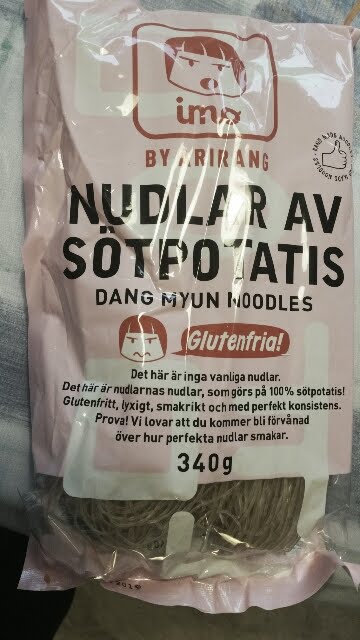 I never tried cooking Korean food myself until a year or two ago when I found out about a Korean blogger, Maangchi, who does YouTube videos of how to cook authentic Korean food. This recipe is inspired by her recipes for Bulgogi and Japchae. Bulgogi is sweet soysauce marinated beef, usually thinly sliced and grilled or pan fried. Japchae is a dish of stir fried glass noodles, made from sweet potato starch called dang myun. These noodles are fairly tasteless on their own but have a nice chewy texture and soak up flavors beautifully. They are also gluten free, for those who are interested. I saw these noodles at my local ICA the other day, so I snatched them up. Wandering down the meat aisle, they had some nice flank steak, which is not that common here in Sweden and so I decided to use the Bulgogi marinade for the beef but grill it whole in the oven, and then slice the meat over the noodles.
Here is how I did it:
Serves 4 to 6
Grilled Flank Steak
1 pear or apple
1 small onion
8 cloves garlic
2 teaspoons grated fresh ginger
4 tablespoons soysauce*
4 tablespoons brown sugar
2 tablespoons toasted sesame oil
black pepper
1 kilo of flank steak
Peel your pear or apple, take out the core and roughly chop it. Stick it in a woozy woo (mini food processor) and process until it is a paste. This is easier to do with a pear, which is the traditional fruit. But I have so many apples in the garden right now, I decided to use that instead and it tasted fine. Peel and roughly chop the garlic and onion and puree in the woozy woo in batches. You can also do this in the food processor or if you don't have one, you could use a mortar and pestle.
Take a large ziplock bag, one which will fit your meat, and dump the ingredients of the marinade into it. Close the bag and knead it to mix up the marinade. Throw in the flank steak, close the bag and knead it, making sure the marinade covers the entire steak. Put in the refrigerator for at least half an hour, but overnight is even better.
 About half an hour before you want to eat, turn on your broiler to its highest setting. Take the steak out of the bag, scraping excess marinade into a little pot and set aside to use in the noodles. Lay the steak on a pan that is covered with aluminum foil (to help contain the mess). Broil for 6 to 15 minutes per side until each side is nicely browned.
  The time will depend on how hot your broiler is and how close to the heating element you can get your meat. If you like your meat rare, then put it as close to the heating element as possible. There should be some bits that look almost burnt. Let the meat rest for 10 minutes and then slice it thinly AGAINST the grain.
Stir Fried Glass Noodles
About 150 grams of dang myun sweet potato noodles
2 large carrots
1/4 head savoy cabbage
15 to 20 fresh shitake mushrooms
1 onion
3 to 4 spring onions
1 to 2 tablespoons of soysauce*
1 tablespoon sesame oil
olive or vegetable oil for frying
salt and pepper to taste
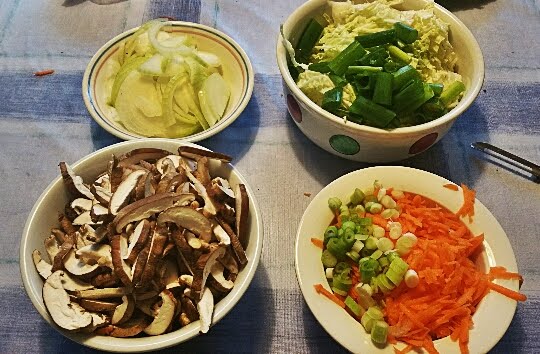 Take a large pot and fill with water and bring to a boil. Meanwhile, prepare your vegetables. Peel and grate the carrot. Take the cabbage and cut out the core and cut into thin strips. Cut off the stem on the mushrooms. You can save the stems to flavor a stock, if you like, otherwise discard. Thinly slice the heads of the shitake mushrooms. Cut the onion in half and then thinly slice. Thinly slice the white part of the spring onions and slice the green portion into 2 cm (about 1 inch) pieces.
Take the little pot of marinade from the meat and put it on the stove. Bring it to the boil and the turn the heat to low and simmer it for 10 minutes. Set aside.
In a large frying pan, heat a glob of oil on high heat. Stir fry each vegetable over high heat separately:
1. Throw in the mushrooms and stir fry for a two to three minutes until they are tender and the edges are a bit browned. Pour the mushrooms into a large serving bowl. Put a plate or lid over the bowl to keep everything warm.
2.Put a bit more oil in the pan and throw in the grated carrot and the white part of the spring onions and a pinch or two of salt. Stir fry for a three to four minutes until the carrot is tender and sweet. Pour the carrot into the bowl with the mushrooms.
3. Add a bit more oil and then stir fry the cabbage, sliced onion and the green part of the spring onion with a pinch of salt until tender and the edges of the cabbage are getting a bit brown, about three to four minutes and then pour into the bowl.
When the water is boiling, add the noodles and cook for about 7 minutes until the noodles are tender. Drain the noodles and add into the bowl. Add the sesame seed oil and a tablespoon of soysauce. Throw in the cooked marinade from the meat. Toss everything together. Taste the noodles and add a bit more soy sauce if it needs more salt. If there are any juices from the grilled flank steak, throw that into the noodles, too. If the vegetables have cooled too much, you can throw the whole thing back in the pan and warm through. Taste and adjust, adding more soysauce and sesame oil if necessary.
Serve the noodles hot with the thinly sliced grilled flank steak on top.

*If you want this recipe to be gluten free, you have to make sure you use a gluten free soysauce, like a Tamari style soy sauce.